Local SEO Trends 2026: What’s Changing Now
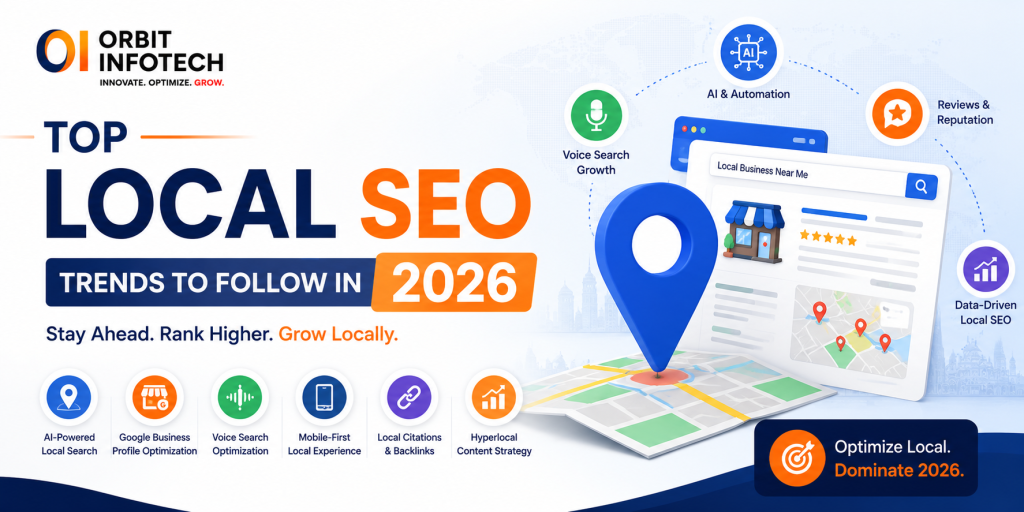
Top Local SEO Trends to Follow in 2026: Local search is changing faster than at almost any point in the last decade. Google is no longer just showing a list of nearby businesses — it’s summarizing, ranking, and sometimes answering the question directly before a searcher ever sees a map pack. For business owners, that shift means the old local SEO playbook needs an update. Here’s what’s actually moving the needle in 2026, and how businesses can adapt — brought to you by the team at Orbit Infotech.
AI-Powered Local Packs Are Changing How Customers Find You
One of the biggest shifts this year is the rollout of AI-generated local packs, currently appearing mostly on mobile searches in the U.S. Instead of the familiar three-listing map pack, Google is testing AI summaries that synthesize information from multiple sources before showing individual business listings. Early data suggests these AI packs surface far fewer unique businesses than traditional three-packs, meaning competition for visibility within them is tighter than ever.
What this means for your business:
- Being “good enough” to rank in a traditional 3-pack may not be enough to appear in an AI-curated pack
- Business information needs to be exceptionally clear, consistent, and well-structured so AI systems can confidently summarize it
- Website clicks from business profiles remain relatively stable even as phone-call clicks decline, suggesting AI summaries are changing user behavior on mobile specifically
Answer Engine Optimization (AEO) Is the New Frontier
Search is moving from “here’s a list of links” to “here’s your answer.” Answer Engine Optimization focuses on helping AI systems — including Google’s AI Overviews, ChatGPT, and Perplexity — understand and trust your business information well enough to recommend it directly.
This shift matters because a growing share of local queries are now being answered inside AI chat interfaces rather than traditional search results. For local businesses, this means:
- Structuring content around clear, direct answers to common customer questions
- Using schema markup so AI systems can accurately parse what your business offers and where
- Building genuine topical depth around your core services rather than one thin page per keyword
Local SEO and AEO are increasingly two sides of the same coin — local SEO gets you into the map pack, AEO gets you selected as the answer.
Your Google Business Profile Is Now Your Primary AI Data Source
If your Google Business Profile used to feel like a secondary listing, that’s no longer the case. It’s increasingly functioning as the primary data source AI systems pull from when generating local search summaries — essentially your new homepage in the eyes of search engines.
To keep it competitive in 2026:
- Use accurate, specific service categories rather than broad, generic ones
- Post regular updates, photos, and offers, treating the profile like an active social feed rather than a static listing
- Respond consistently to reviews and questions, since engagement signals are increasingly weighed as trust indicators
- Encourage reviews that mention specific services by name — AI systems are evaluating review content, not just star ratings, to determine relevance
Entity and Topical Authority Matter More Than Keyword Density
Search engines increasingly treat businesses as real-world “entities” rather than collections of keyword-optimized pages. This means Google is trying to understand what your business genuinely offers and where it operates, rather than just matching text on a page to a search query.
Practical ways to build entity and topical authority in 2026:
- Cover each core service with its own dedicated page, supported by related content answering common customer questions
- Keep your Name, Address, and Phone number (NAP) identical across every online listing and directory
- Build internal links between related service pages and blog content so search engines can map the relationships between topics
- Avoid publishing thin, one-off pages that don’t connect to a broader content ecosystem
Local Services Ads Are Expanding Rapidly
Paid visibility is playing a growing role in local search results. Local Services Ads, once appearing on a modest share of tracked local queries, have nearly tripled their visibility over the course of a single year. For competitive service categories, this means organic rankings alone may no longer capture the full available search traffic.
Businesses serious about local visibility in 2026 should consider:
- Testing Local Services Ads alongside organic local SEO rather than treating them as separate strategies
- Monitoring how paid placements affect organic click-through rates in your specific market
- Budgeting for a blended approach rather than relying exclusively on free/organic visibility
Multi-Location Strategy Is Becoming a Competitive Necessity
Even businesses with a single, well-optimized Google Business Profile are reportedly seeing declining traffic per listing as competition and AI summarization reduce the visibility any one profile receives. For businesses capable of expanding, opening additional locations — or at minimum, building location-specific landing pages for each service area — can help offset this decline by capturing visibility across more individual profiles and pages.
“Search Everywhere” Optimization Beyond Google
Local discovery is no longer confined to Google alone. Customers are increasingly researching local businesses through platforms like YouTube, Reddit, and social media, in addition to traditional search engines and AI chat tools. A newer framework circulating in the industry — often summarized around the pillars of Freshness, Authority, Consistency, Trust, and Semantic Relevance — reflects this broader shift toward optimizing visibility across every platform customers use to make decisions, not just Google Search.
Practical steps include:
- Maintaining active, updated profiles on relevant social and review platforms, not just Google
- Encouraging video content and customer testimonials that can surface in platforms like YouTube
- Monitoring brand mentions across community platforms like Reddit, which increasingly influence AI-generated recommendations
Reviews Are More Influential Than Ever
The vast majority of consumers now read online reviews before choosing a local business, and businesses with a limited number of reviews or lower average ratings face a measurable disadvantage in both traditional rankings and AI-driven recommendations. Interestingly, businesses selected by AI chat tools tend to have notably higher average star ratings than typical Google or Yelp benchmarks — suggesting AI systems may apply a higher trust threshold than traditional search ranking factors.
To stay competitive:
- Actively request reviews that reference specific services, not just generic praise
- Respond to every review, positive or negative, to demonstrate active engagement
- Address negative reviews professionally and promptly, since AI systems appear to weigh overall trust signals rather than isolated ratings
Technical SEO Remains the Non-Negotiable Foundation
With so much attention on AI and content strategy, it’s easy to overlook that technical fundamentals still underpin everything else. Mobile-first indexing, fast load times, and clean crawlability remain essential — no amount of content strategy or review generation compensates for a slow, hard-to-crawl website.
Core technical priorities for 2026 include:
- Strong Core Web Vitals performance, since page speed continues to directly affect both rankings and user experience
- Mobile optimization, given that most local searches happen on mobile devices
- Clean site structure that allows search engines to easily discover and index every service page
Quality Local Backlinks Over Quantity
Directory-style link building, once a cornerstone tactic, has become a much lower priority in 2026. Instead, a small number of genuinely authoritative local backlinks — from local news outlets, community organizations, or industry-relevant local sources — now carry significantly more weight than large volumes of generic directory listings.
Bringing It All Together
Local SEO in 2026 isn’t about chasing a single tactic — it’s about building a complete, trustworthy presence across Google, AI search tools, and the broader platforms your customers actually use to make decisions. Google Business Profile optimization, genuine topical authority, review quality, technical performance, and adapting to AI-driven search all now work together rather than as separate checklist items.
At Orbit Infotech, we help local businesses navigate exactly this kind of shifting landscape — building strategies that keep pace with how search engines and AI tools are evolving, rather than relying on outdated tactics that no longer move the needle.
If your local visibility strategy hasn’t been updated for how search actually works in 2026, now is the time to revisit it — before your competitors capture the customers who are searching for you right now.
Frequently Asked Questions – Top Local SEO Trends to Follow in 2026
1. What is the biggest local SEO change in 2026?
The rise of AI-powered local packs and Answer Engine Optimization (AEO) is the most significant shift. Google and other AI search tools are increasingly summarizing information and recommending businesses directly, rather than simply listing links, making trust and clarity more important than traditional keyword tactics.
2. Is Google Business Profile still important in 2026?
Yes — arguably more than ever. Your Google Business Profile has become a primary data source for AI-driven local search results, functioning much like a homepage that AI systems reference when generating summaries and recommendations.
3. What is Answer Engine Optimization (AEO)?
AEO focuses on helping AI systems like Google’s AI Overviews, ChatGPT, and Perplexity understand and trust your business information well enough to recommend it directly as an answer, rather than just ranking your website among a list of links.
4. Do online reviews still matter for local SEO?
Yes, significantly. Review quantity, rating, and the actual content of reviews all influence both traditional rankings and AI-driven recommendations. AI systems specifically evaluate whether reviews mention the services you want to rank for, not just star ratings alone.
5. Is directory-based link building still effective in 2026?
Not as much as before. Quality has overtaken quantity — a small number of genuinely authoritative local backlinks, such as from local news outlets or community organizations, now carry far more weight than large volumes of generic directory listings.
6. Should my business open multiple locations for better local SEO?
For businesses capable of expansion, a multi-location strategy can help offset declining visibility per individual Google Business Profile listing. At minimum, building dedicated location-specific landing pages can achieve a similar effect.
7. Are Local Services Ads worth investing in?
Local Services Ads have expanded rapidly in visibility over the past year, particularly in competitive service categories. A blended approach combining organic local SEO with paid Local Services Ads is increasingly worth considering.
8. How does entity and topical authority affect local rankings?
Search engines increasingly treat businesses as real-world “entities” rather than isolated web pages. Building topical authority through interconnected service pages, consistent business information, and genuine content depth helps establish this trust more effectively than keyword-focused pages alone.
9. Does local SEO still matter if most searches happen through AI tools now?
Yes. Local SEO and AEO now work together — local SEO helps you appear in map packs and traditional local results, while AEO increases your chances of being selected as the direct answer within AI-powered search experiences.
10. What technical factors still matter for local SEO in 2026?
Core Web Vitals, mobile optimization, and clean site structure remain essential. No amount of content strategy or review generation can compensate for a slow, difficult-to-crawl website.
11. How long does it take to see results from updated local SEO strategies?
Results vary by market and competition level, but noticeable improvements in AI visibility and local rankings often appear within a few months when Google Business Profile details, content, and technical fundamentals are properly optimized.
12. Should I be optimizing for platforms beyond Google in 2026?
Yes. Customers increasingly research local businesses through platforms like YouTube, Reddit, and social media in addition to Google. A “search everywhere” approach that maintains consistent, active profiles across multiple platforms is becoming essential for complete local visibility.
Recent Comments